BUSINESS VISIBILITY
Beyond SEO: How to Get Your Business Found on Google and AI Search
Keep SEO as your foundation. Make your business easier to find, understand and verify across Google, Maps, directories and AI-powered answers.
By Nansen Systems ·
Sources checked:

To increase your business’s discoverability, keep SEO as your foundation—but expand your strategy beyond rankings and website traffic. Make your content easy to find, understand, and verify, while strengthening your presence wherever customers evaluate businesses: search results, Maps, industry directories, and AI-powered answers.
AI search has changed how information reaches customers. Someone may encounter your business through a generated summary or a local listing before visiting your website. The practical response is not to abandon SEO or chase a new acronym. It is to build a connected visibility strategy that supports both traditional search and answer-driven discovery.
1. Understand Where SEO Fits
SEO still helps search engines discover and interpret your pages. Technical accessibility, relevant content, internal links, and credible external references remain important.
What has changed is the range of places where that information can appear.
Alongside SEO, you may encounter three related terms:
- AEO, or answer engine optimization: Organizing content to answer specific questions clearly, including questions that may appear in search features or voice responses.
- GEO, or generative engine optimization: Making information useful and credible for AI systems that retrieve sources and generate answers.
- AIEO, or artificial intelligence engine optimization: A broader label sometimes used for improving visibility in AI-powered search experiences.
These labels overlap, and their definitions are not universally standardized. They are better understood as complementary practices than separate marketing channels.
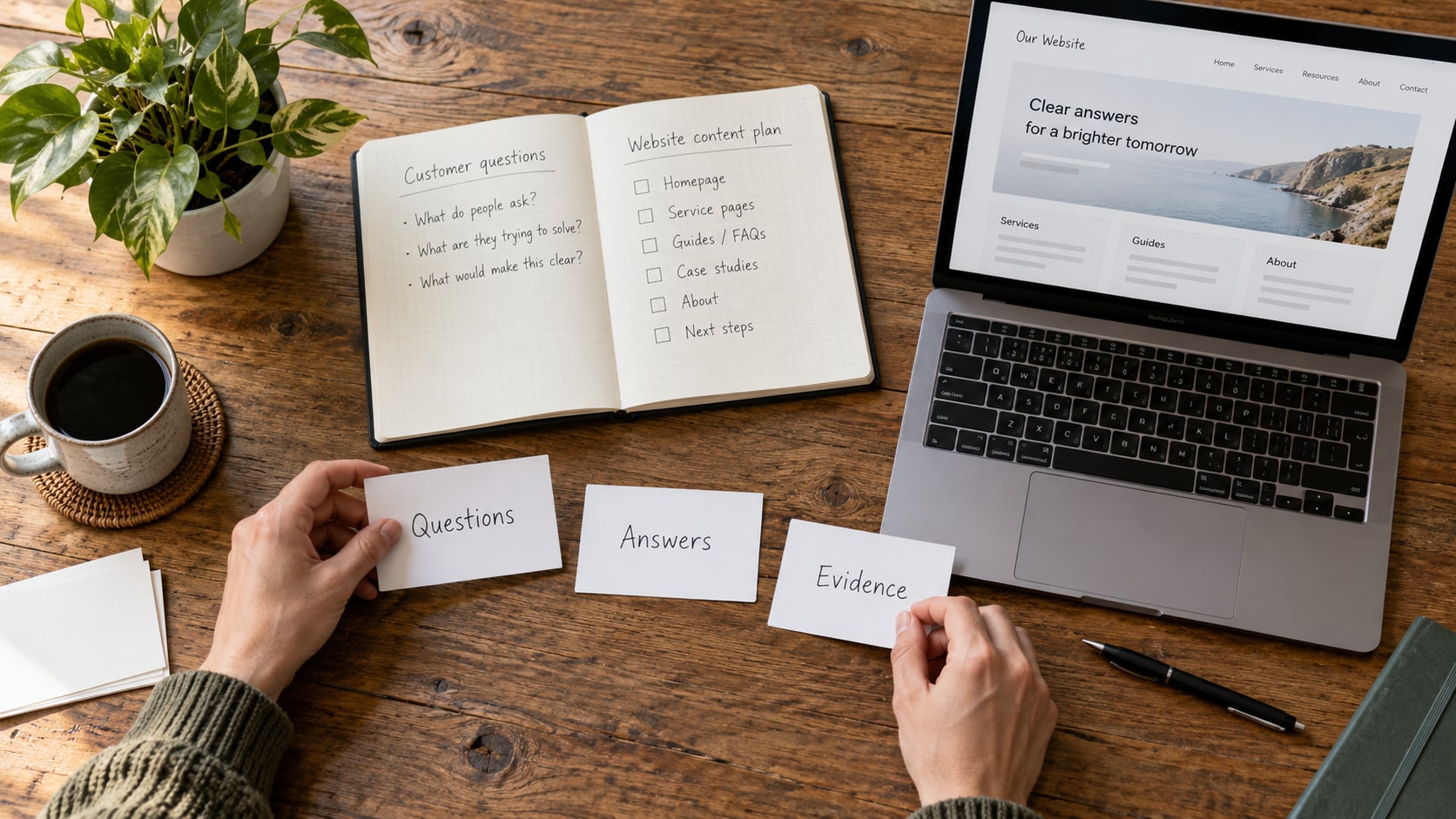
A useful working model is: SEO supports discovery; clear answers support understanding; trustworthy evidence supports evaluation. None guarantees that an AI system will mention or cite your business.
2. Map the Questions Behind Customer Decisions
Start with customer needs, not a list of trending optimization terms.
Review sales conversations, support requests, website search queries, and available search-performance data. Identify the questions people ask before choosing a provider.
Group them into three stages:
- Understanding the problem: “Why does this keep happening?”
- Comparing solutions: “Which approach fits our requirements?”
- Choosing a business: “Who offers this service, what does it cost, and what happens next?”
Prioritize questions that connect directly to your offering and that you can answer with genuine detail.
For example, a commercial cleaning business could explain how cleaning frequency varies by facility type, what an initial assessment covers, and which factors affect a quote. That is more useful than publishing a generic article about the importance of clean workplaces.
Create a question-to-page map. Assign each important question to an existing page or a planned resource, avoiding multiple thin pages that repeat the same answer.
3. Fix the Technical Foundation Before Adding Content
Clear writing cannot compensate for a website that search systems struggle to access.
Check your most important service, product, and informational pages for:
- Accidental indexing restrictions or blocked access.
- Broken links, redirect problems, and duplicate versions.
- Important information available only in images or difficult-to-access interfaces.
- Confusing navigation and weak internal linking.
- Poor mobile usability or slow, cumbersome page experiences.
Use Google Search Console to inspect important URLs and review indexing issues. Keep your XML sitemap aligned with the pages you want discovered.
For AI services, distinguish between crawlers used for search retrieval and those used for model training. Access policies and controls vary by provider, so review the relevant documentation before changing crawler permissions. Allowing access does not guarantee inclusion.
Where appropriate, add supported structured data that accurately reflects visible page content. Organization, LocalBusiness, Product, or other relevant types can help describe a page’s entities and attributes. Structured data is not a shortcut to rankings or AI citations.
4. Make Every Important Page Answer-Ready
Build pages for people who need a quick answer and people who need deeper explanation.
A practical structure is:
- Lead with the answer. Explain the central point in a few direct sentences.
- Organize the details. Use descriptive headings that reflect real customer questions.
- Explain conditions and limitations. Show when the answer changes.
- Provide supporting evidence. Include relevant examples, methods, or approved sources.
- Make the next step clear. Help readers understand what to do with the information.
For a pricing page, do more than say “contact us for a quote.” Explain the variables that influence cost, what is included, and what information you need to estimate accurately.
Use lists for sequences and tables for genuine comparisons—not simply to make content look optimized. FAQ sections are useful when they address unanswered questions, not when they repeat the entire page.
5. Publish Details Only Your Business Can Provide
Generic summaries are easy to reproduce. Specific, accurate business information gives customers a stronger reason to trust you.
Useful original material includes:
- How your service or delivery process works.
- What customers should prepare before an appointment.
- Common constraints and how you handle them.
- Product specifications and suitability limits.
- Documented project examples, shared with permission.
- Clear explanations from the people responsible for the work.
Identify authors or reviewers when their expertise is relevant. Explain credentials accurately, and use publication or revision dates honestly. Changing a date without improving the content does not make it more useful.
Separate factual claims from opinion. If you publish statistics, performance results, or comparisons, verify them and retain the supporting evidence. Remove unsupported claims rather than presenting confidence as proof.
6. Strengthen Your Presence Beyond Your Website
Your website is central, but customers may discover and assess your business elsewhere.
For businesses eligible for a Google Business Profile, keep core information accurate: business name, category, hours, location or service area, and contact details. Maintain consistency across relevant directories and professional profiles.
Focus on platforms your customers actually use. Depending on your business, these could include industry associations, marketplaces, review sites, or specialist publications.
Build external credibility through legitimate activity:
- Invite customers to leave honest reviews without prescribing the outcome.
- Contribute useful expertise to relevant publications.
- Keep partner and association listings current.
- Correct inaccurate descriptions of your business.
These activities create additional discovery opportunities and help people verify who you are. They should not be treated as guaranteed routes into AI answers.
7. Measure Discoverability, Not Just Traffic
Website sessions remain useful, but they are only part of the picture.
Track a combination of search impressions, relevant queries, qualified inquiries, conversions, local profile interactions where available, and referral traffic from identifiable AI services.
Ask new customers how they found you, allowing multiple answers. Someone may see a search result, read reviews, and consult an AI assistant before making contact.
You can also periodically test a consistent set of customer questions across search and AI tools. Record the date, platform, and response context. Treat the findings as a snapshot—not a stable ranking report—because generated answers can vary.
Start With One High-Value Customer Journey
You do not need a separate strategy for every acronym. You need accurate business information, accessible pages, useful answers, and credible evidence across the places customers look.
Choose one high-value service this week. Map its key customer questions, improve the pages that answer them, and check that your business information is consistent elsewhere. Then measure qualified inquiries alongside visibility. That focused approach gives you a practical starting point for discovery beyond traditional SEO.
Nansen’s perspective
Start with the real questions your customers ask. A useful company knowledge base can help your team keep facts, answers and supporting evidence consistent across your website and other business profiles.
Keep people at the center
Check every claim with the person responsible for the work. Share customer stories only with permission, keep private company files private, and do not promise a search ranking or an AI recommendation.
The takeaway
Choose one high-value service, answer its customer questions clearly, support those answers with evidence, and measure qualified inquiries—not just page visits.
Put the ideas to work.
Learn to build your company’s AI Twin with us, or have Nansen build it for you.